

The Place/The Center

If you take each letter’s gematria value of יהוה (mispar hechrachi) and square them and then in the end you sum the squares, the value is 186. Squaring each letter individually and then summing them up is called Mispar ha-Meruba ha-Prati (מִסְפָּר הַמְּרוּבָּע הַפְּרָטִי).
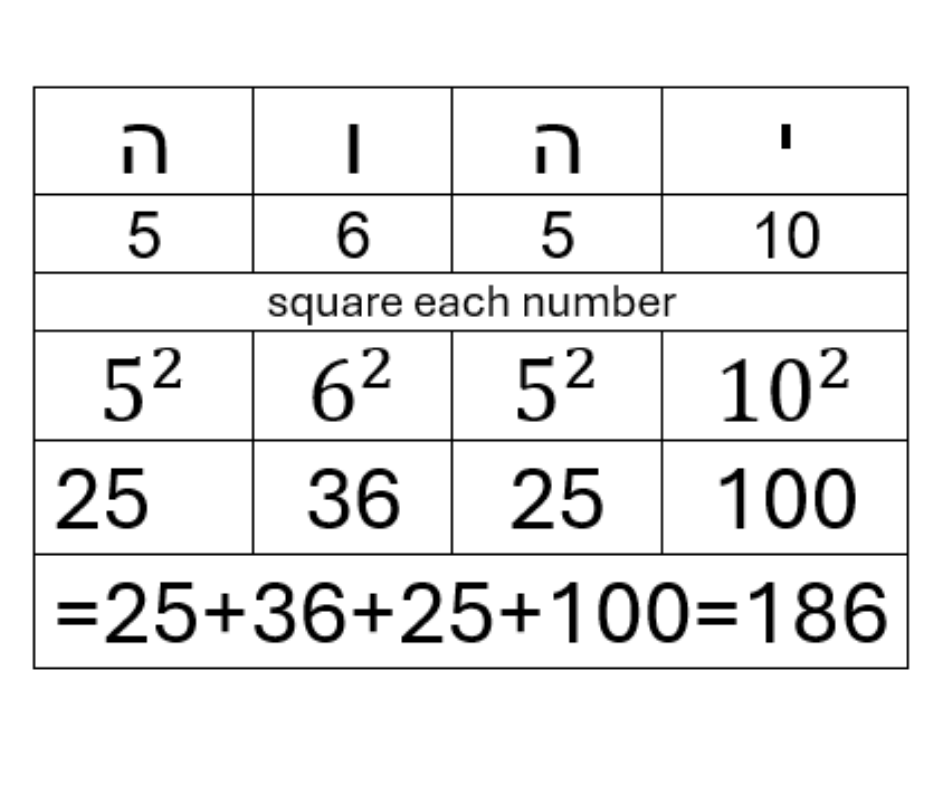
Number 186 is an interesting number in terms of the place/location.
The word Makom (186) in Hebrew means place.

“Then on the third day Abraham lifted up his eyes, and saw the place afar off” (Genesis 22:4 KJV)
“And the LORD said, Behold, there is a place by me, and thou shalt stand upon a rock:” (Exodus 33:21)

Another interesting thing is that the number 186 is the gematria of the word קוֹף (Qof).
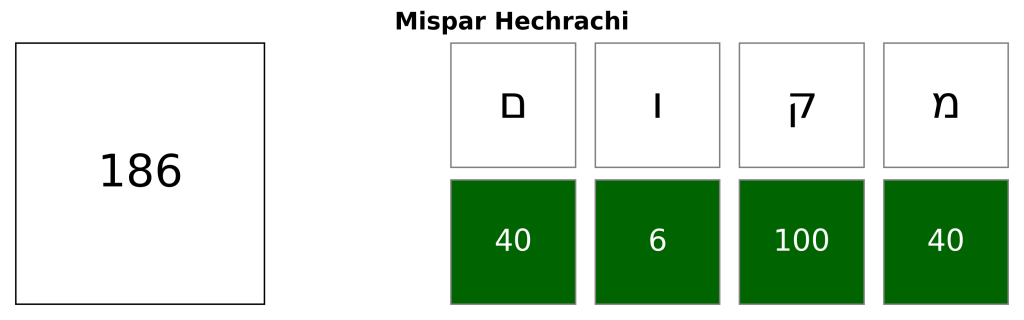
The Hebrew letter ק (Qof) has a gematria value of 100.

Also Israel’s value of 541 is the 100th prime number.


Now we know that the speed of light is approximately 186,000 miles per second.
186 *1000
“I am the light of the world” – John 8:12
186 miles per hour is approximately 300 kilometers per hour, a representative of the letter Shin (ש) where we have the word אֵשׂ (fire).

In Midrash Bereishit Rabbah 68:9* “God is the place of the world” signifying his omnipresence.
“the Holy One blessed be He is the place of the world, and His world is not His place.”
God is not limited to a specific location, he can be found anywhere and the place becomes sacred.

“And he said, Draw not nigh hither: put off thy shoes from off thy feet, for the place whereon thou standest is holy ground.” (Exodus 3:5 KJV)

Mircea Eliade touches on the concept of the Sacred and the Profane. The holy place is a place of the presence of God, a place of order out of the chaos of the profane world.
And at this sacred place we find the center of the world.

This sacred place is the Axis Mundi an archetype that connects God and humans, heaven and earth.

“The CENTER, then, is pre-eminently the zone of the sacred, the zone of absolute reality.”**

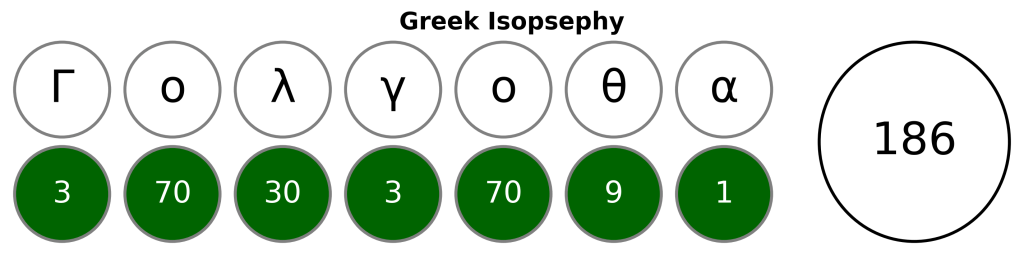
If we look at two words Makom and Golgotha they have the same numerical value of 186.
Note: The word Golgotha (Matthew 27:33), or “the place of the Skull” where Christ was crucified is also known as Calvary, a name from Latin word “calvaria” meaning “skull”.
The 186th verse in the Bible is Exodus 10:3.

The 186th prime number is 1109. Interestingly 11/09 (November 9) is the 314th day of the leap year.

The place of profane, a hill of executions now became a sacred place because of the Christ’s crucifixion.

*https://www.sefaria.org/Bereshit_Rabbah.68.9?lang=bi&with=all&lang2=en
**The Myth of the Eternal Return Cosmos and History, Mircea Eliade, Princeton University Press, 2018, pp. 17.

The Face of the Other

The famous story in Exodus of Moses’ encounter with God, but can’t see the face of God and only his back is very meaningful and studied. Since God is divine and transcends time and space and our dimensions it makes sense that no one can see the face of God and live. (Exodus 33:23).

He is the Most High God עליון (Most High – Psalm 7:17), very powerful פני יהוה (The face of the LORD – Psalm 34:16 KJV) and who sees everything עיני יהוה (The eyes of the LORD – Proverbs 15:3 KJV).

In his book “Totality and Infinity” Levinas* touches on the concept on the face of the other. It is precisely this encounter phenomena that he analyzes. It is the meetup where you face the Other, and the Other is present, is there, is alive and their face speaks even if words are not spoken and as Levinas states “…The manifestation of the face is already discourse”
When we see the Other, we dethrone the “I”, our ego and we are obligated to act ethically.

“To approach the Other in conversation is to welcome his expression, in which at each instant he overflows the idea a thought would carry away from it. It is therefore to receive from the Other beyond the capacity of the I, which means exactly: to have the idea of infinity.”
(Levinas, Totality and Infinity, 51)

“The face is a living presence; it is expression. The life of expression consists in undoing the form in which the existent, exposed as a theme, is thereby dissimulated. The face speaks. The manifestation of the face is already discourse.”
(Levinas, Totality and Infinity, 66)

Jesus’ commandment to love “the other” our brother/sister is for eternity. It is a commandment that we must follow. It obligates us to look at our brother/sister (the Other) and love them because to love is divine.

“If a man say, I love God, and hateth his brother, he is a liar: for he that loveth not his brother whom he hath seen, how can he love God whom he hath not seen? And this commandment have we from him, That he who loveth God love his brother also.” (1 John 4:20-21)

God is infinite and his love is beyond our imagination. It is not a surprise that love of your neighbour is mandatory if you claim to love God (Matthew 22:37-40).

“Jesus said unto him, Thou shalt love the Lord thy God with all thy heart, and with all thy soul, and with all thy mind. This is the first and great commandment. And the second is like unto it, Thou shalt love thy neighbour as thyself. On these two commandments hang all the law and the prophets.” (Matthew 22:37-40)

Simone Weil** a philosopher and mystic wrote on the topic of the forms of the implicit love of God that we imitate the divine love when loving our neighbour. In fact the name of Ἰησοῦς Χριστὸς (Jesus Christ) and the phrase (αγαπα και τον αδελφον αυτου – love his brother also) in 1 John 4:21 have the same value of 2368. It is a movement of infinite (∞) love.

Although man was created in the image of God (בְּצֶ֥לֶם אֱלֹהִ֖ים – bə·ṣe·lem ĕ·lō·hîm – Genesis 1:26-27), it is only through the true mediator Christ (1 Timothy 2:5), who is the perfect image of God (εἰκὼν τοῦ Θεοῦ – eikōn tou Theou – Colossians 1:15) where we have salvation.

“Through love of neighbour, we imitate the divine love that created us and our fellows. Through love of the order of the world, we imitate the divine love that created this universe of which we are a part.”
(Weil, Awaiting God, 62)

References:
*Levinas, Emmanuel. Totality and Infinity: An Essay on Exteriority. Translated by Alphonso Lingis. Pittsburgh: Duquesne University Press, 1969
**Weil, Simone. Awaiting God: A New Translation of Attente de Dieu and Lettre à un Religieux. Translated by Brad Jersak. Eugene, OR: Cascade Books, 2012.